Introduction
Many beginners start learning AI by searching for one perfect tool.
They want one platform that can write captions, create images, generate videos, improve visuals, make reels, design ads and create campaign assets.
But practical AI work does not happen like that.
Ready to turn these ideas into practical skills? Explore the complete AI course curriculum.
What Is Multi-Engine AI Practice?
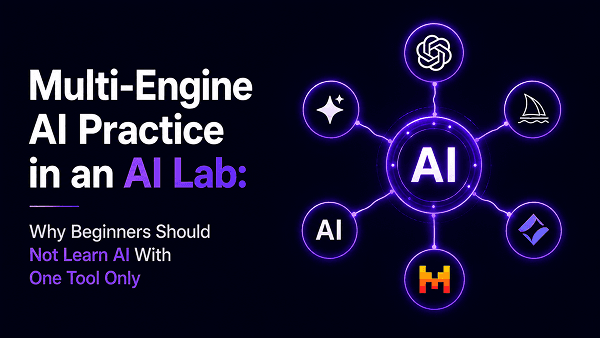
Multi-engine AI practice means learning how different AI tools or AI engines support different types of outputs.
For example, one workflow may help with captions, hooks and scripts. Another workflow may help with product visuals. Another may support image-to-video or motion. Another may help create campaign assets by combining text, visuals and video direction.
This does not mean beginners need to master every AI tool in the market.
That is not the point.
The point is to understand tool behaviour.
A good AI Lab gives beginners guided exposure to different AI workflows so they can understand what each tool category is useful for.
Instead of asking, “Which AI tool is best?” learners start asking, “Which AI engine or workflow is right for this task?”
That shift makes AI learning more practical.
Why One AI Tool Is Not Enough
One AI tool can be useful, but it usually cannot handle every creative task properly.
A writing tool may help with captions, scripts and ad copy. But it may not create strong product visuals.
An image tool may help with visual concepts, backgrounds and product-style images. But it may not create smooth video motion.
A video tool may add motion to an image. But it still needs a strong keyframe, clear scene direction and proper camera movement.
A complete campaign asset may need all of these working together.
This is why one-tool learning can feel incomplete.
A learner may create a caption but still need a product visual. They may create an image but still need a reel concept. They may create a video but still need a caption, CTA and ad angle.
Inside an AI Lab, learners understand how different tools connect inside one creation process.
That is what makes multi-engine AI practice valuable.
How AI Lab Reduces Tool Confusion
Tool confusion happens when beginners know tool names but do not know tool purpose.
They hear about new AI tools every week. One tool is trending for images. Another is trending for video. Another is trending for content. Another promises better quality.
This creates pressure to keep trying everything.
But trying many tools without a workflow does not build skill.
Inside an AI Lab, tools are connected to use cases.
For example:
* Content workflow helps with captions, hooks, scripts and ad ideas.
* Image workflow helps with product visuals, backgrounds, lighting and composition.
* Video workflow helps with motion, image-to-video, camera movement and short scenes.
* Campaign workflow helps connect text, visuals, reels and ad creatives.
This structure helps beginners understand why they are using a tool.
They stop opening platforms randomly.
They start choosing workflows based on output goals.
How Different AI Engines Support Different Workflows
Different AI engines are useful for different stages of creative production.
For content creation, learners may practice hooks, captions, scripts, voiceover lines, ad angles and campaign messages.
For AI image generation, learners may practice product visuals, lifestyle scenes, campaign references, thumbnails, mockups and brand-style visuals.
For AI video and image-to-video, learners may practice keyframes, motion prompts, camera movement, product teasers and reel concepts.
For campaign creation, learners may connect multiple outputs together: caption, image, reel idea, ad copy and WhatsApp message.
This is the real use of multi-engine AI practice.
The learner does not use many tools for the sake of using tools.
The learner uses different tools because different outputs need different workflows.
Example: One Product, Multiple AI Workflows
Let’s say a business owner wants to promote a new skincare product.
A beginner may open one tool and type:
“Create content for my skincare product.”
The output may be generic.
Inside an AI Lab workflow, the process becomes more structured.
First, the learner creates a brief:
* Product: skincare serum
* Audience: young working professionals
* Message: simple daily glow routine
* Tone: clean, premium and trustworthy
* Use case: Instagram and WhatsApp campaign
Then the learner uses different AI workflows.
* Content workflow: create hooks, captions and ad angles.
* Image workflow: create a clean product visual with soft lighting.
* Video workflow: add motion to the product visual for a short reel.
* Campaign workflow: create Instagram post copy, reel caption, WhatsApp message and ad variation.
Now one product idea becomes multiple usable assets.
This is why multi-engine AI practice is powerful inside an AI Lab.
It helps learners connect tools to real work.
Why Multi-Engine Practice Builds AI Judgment
Beginners often think AI learning means knowing more tools.
But practical AI learning is about better judgment.
* Which workflow fits this task?
* Which output is usable?
* Which result is weak?
* Should the prompt change?
* Should the tool category change?
* Should the visual direction improve?
* Should the output be refined or restarted?
Inside an AI Lab, learners practice these decisions.
They compare outputs from different workflows. They understand how different AI engines respond.
They learn when a tool is useful and when it is not the right fit.
This builds confidence.
The learner does not panic when one tool gives a weak result. They learn how to review, refine or choose a better workflow.
That is a practical AI skill.
Who Benefits From Multi-Engine AI Practice?
Multi-engine AI practice is useful for different types of learners.
Students can create portfolio samples, social media mockups, campaign ideas, product visuals and reel concepts.
Business owners can create product creatives, festival offers, WhatsApp banners, ad variations and social media campaign assets faster.
Creators, marketers and agencies can test visual directions, build moodboards, create reel ideas, prepare campaign variations and support client-facing work.
For all these learners, the value is not just tool access.
The value is workflow control.
An AI Lab helps learners understand how different AI engines work together to create real outputs.
FAQ
What is multi-engine AI practice?
Multi-engine AI practice means learning how different AI tools or AI engines support different outputs such as content, images, videos, motion and campaign assets.
Does multi-engine AI practice mean learning every AI tool?
No. The goal is not to learn every tool. The goal is to understand which tool category fits which workflow.
Why is AI Lab useful for multi-engine practice?
An AI Lab gives guided practice across different AI workflows so learners can test, compare, refine and understand tool behaviour without random tool chasing.
Should beginners start with one AI tool or an AI Lab?
Beginners should start with workflow clarity. An AI Lab helps them understand which tool to use after they know what output they want to create.
Final Thoughts
Multi-engine AI practice matters because real AI work does not happen inside one tool only.
A complete content or campaign asset may need text, image, video and motion workflows working together.
That is why an AI Lab is valuable.
It helps beginners understand how different AI engines support different tasks, how to choose the right workflow and how to connect outputs into final assets.
The goal is not to collect AI tools.
The goal is to create better work with the right AI workflow.
Download the AI Lab Tool Selection Checklist and understand which AI workflow fits content, image, video and campaign creation.
And if you want to practice this in a guided way, you can explore the Practical GenAI Course with AI Lab access. The course is designed for beginners who want live learning, AI Lab practice, no-code workflows, practical assignments and real outputs like prompts, images, product visuals, reels, captions, ad creatives and campaign assets.
The focus is simple: learn how to use AI engines through workflow, not random tool switching.
Start Your AI Journey Today
Join India's #1 Generative AI course and master the future of creative intelligence.