Introduction
Most people think prompt engineering means writing longer prompts.
That is not true. A long prompt can still create weak output if the idea is unclear.
A short prompt can also work well if the brief, direction and format are clear.
Real prompt engineering is not about adding more words. It is about moving from an idea to a usable output with control.
Ready to turn these ideas into practical skills? Explore the complete AI course curriculum.
Why Random Prompts Create Random Output
Random AI prompts usually fail because they do not give enough direction.
A beginner may write something like:
“Create a product ad.”
This is too broad.
What product is it?
Who is the audience?
Is the style premium, festive, minimal or casual?
Is the output for Instagram, WhatsApp, a reel, an ad creative or a product page?
Should the image have a model, a studio background, a lifestyle setting or a close-up shot?
When these details are missing, the AI tool guesses. And when the tool guesses, the output becomes random.
This is why prompt engineering should not start with the prompt.
It should start with the brief.
Inside an AI Lab, learners understand that better AI prompts come from better input thinking. The prompt is not only a sentence. It is a direction system.
What Is the Brief-to-Final-Asset Workflow?
The Brief-to-Final-Asset workflow is a simple way to create better AI output.
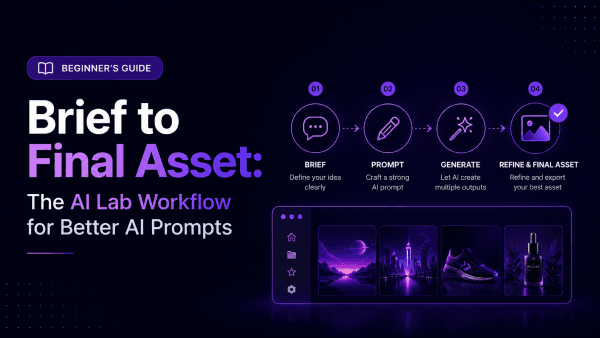
It follows this sequence:
Brief → Prompt → Output → Fix → Refine → Final Asset
First, you create a clear brief. This means defining what you want to create, who it is for, where it will be used and what the final output should communicate.
Then you convert that brief into an AI prompt. This is where you add subject, setting, style, format, camera, lighting, tone, constraints and important details.
After that, you generate the first output.
But the first output is not the final result.
You review it.
You check what is working and what is weak. Maybe the background is messy. Maybe the lighting is flat. Maybe the message is not clear. Maybe the visual does not look useful for the platform.
Then you fix one thing at a time and refine the prompt.
This is how a random AI result slowly becomes a usable final asset.
That is the real value of AI Lab practice.
It teaches learners how to improve output, not just generate output.
How AI Lab Helps You Practice Prompt Engineering
Prompt engineering is a practice skill.
You cannot master it only by reading prompt lists.
You improve when you test, compare, review and correct outputs across different formats.
This is where the AI Lab becomes useful for beginners. Inside an AI Lab, learners do not only write prompts. They understand how prompts behave inside different AI tools and workflows.
A content prompt is different from an image prompt.
An image prompt is different from a video prompt.
A product visual prompt is different from a reel prompt.
A campaign asset prompt is different from a caption prompt.
When learners practice inside an AI Lab, they begin to understand these differences. They learn how to give clearer instructions, how to judge output quality and how to refine weak results.
For example, if an image output looks dull, the learner may improve the lighting instruction. If the product shape is wrong, the learner may make the subject description more specific. If a reel concept feels weak, the learner may improve the hook, visual beat or audience angle.
This is why AI Lab workflow is stronger than random prompt copying.
It teaches control.
Example: Turning One Product Idea Into a Better AI Prompt
Let’s say a business owner wants to create a visual for a handmade jewellery product.
A beginner may write:
“Create a beautiful jewellery image.”
This prompt may create something, but the result will likely be generic.
Inside an AI Lab workflow, the learner starts with a better brief.
* Product: handmade gold-plated earrings
* Audience: young women looking for festive jewellery
* Use case: Instagram ad creative
* Style: premium, warm, elegant
* Setting: soft festive background
* Camera: close-up product focus
* Lighting: warm studio lighting
* Constraint: single product, clean composition, no text
Now the AI prompt becomes more useful because the direction is clear.
The learner is not simply asking AI to “make something beautiful.” The learner is guiding the output.
If the first result is too crowded, the learner can fix the background. If the earrings are not clear, the learner can refine the subject. If the image feels too artificial, the learner can adjust the lighting and style.
This is the prompt-to-output workflow in action.
The goal is not to create one perfect prompt in the first attempt.
The goal is to know how to improve the output step by step.
Why Better Prompts Need Better Review
Many beginners stop too early.
They generate one output and decide whether it is good or bad. But real prompt engineering requires review.
Inside an AI Lab, learners are trained to ask better questions after the first output:
* Is the subject clear?
* Is the style matching the brief?
* Is the lighting suitable?
* Is the format right for the platform?
* Is the output usable for real content?
* What exactly needs to change?
This review stage is important because AI output improves when feedback becomes specific.
Instead of saying, “This does not look good,” the learner learns to say:
* “The background is too busy.”
* “The product is not sharp enough.”
* “The camera angle needs to be closer.”
* “The caption tone is too generic.”
* “The reel idea needs a stronger first line.”
This is how prompt engineering becomes practical.
Why AI Lab Prompt Practice Matters for Beginners
Prompt engineering is not only useful for people who want to write better text. It is useful across content, images, videos, ads, reels, product visuals and campaign assets.
A student can use better AI prompts to create portfolio samples.
A business owner can use better prompts to create product visuals, captions and social media ideas.
A creator or marketer can use prompt workflows to build campaign angles, reel concepts, ad variations and visual directions.
But in every case, the skill is not just prompt writing.
The skill is prompt thinking.
That means knowing what output you want, how to brief the AI tool, how to judge the result and how to refine it into something usable.
This is exactly what an AI Lab helps beginners practice.
FAQ
What is prompt engineering?
Prompt engineering is the process of giving clear instructions to an AI tool so it can create better text, image, video or creative output. In practical learning, it also includes reviewing and refining the output.
Can beginners learn prompt engineering?
Yes. Beginners can learn prompt engineering without coding. The best way to learn is through a guided workflow where they create briefs, write prompts, test outputs and improve results.
Is prompt engineering useful for images and videos?
Yes. Prompt engineering is useful for AI images, product visuals, AI videos, reel concepts, captions, ad creatives and campaign assets. Each format needs a different type of prompt structure.
Final Thoughts
Better AI prompts do not come from copying longer prompt templates.
They come from better workflow.
When learners understand the journey from brief to final asset, prompt engineering becomes more practical. They stop depending on random prompts and start building control over the output.
That is why AI Lab practice matters.
It helps beginners test prompts, compare outputs, fix weak results and turn ideas into usable assets.
If you want to start practicing this process, download the Prompt-to-Output Cheat Sheet and learn the basic workflow: Brief → Prompt → Output → Fix → Refine → Final Asset.
And if you want to learn prompt engineering in a more guided way, you can explore the Practical GenAI Course with AI Lab access. The course focuses on live learning, no-code workflows, AI Lab practice, practical assignments and real outputs like prompts, images, product visuals, reels, captions, ad creatives and campaign assets.
The focus is simple: learn AI prompts through practice, not random copying.
Start Your AI Journey Today
Join India's #1 Generative AI course and master the future of creative intelligence.