Introduction
Artificial Intelligence is no longer just for developers and engineers. In 2026, AI has become a practical skill for students, marketers, freelancers, business owners, and creators. This guide explores how beginners can learn AI effectively, what to look for in an AI course, and why practical GenAI workflows are becoming essential for modern careers and businesses.
Ready to turn these ideas into practical skills? Explore the complete AI course curriculum.
Best AI Course in India: Practical Guide for Beginners in 2026
Artificial intelligence is no longer only for engineers, developers, or technology companies. In 2026, AI has become a practical work skill for students, freelancers, marketers, creators, business owners, and agency teams.
People are not learning AI only to understand the technology. They want to use it.
They want to create images, reels, product visuals, ad creatives, captions, scripts, campaign ideas, social media posts, and client-ready assets. This is why more learners are now searching for the best AI course in India.
But choosing the right AI course is not easy.
There are too many tools, too many tutorials, too many courses, and too many random AI tricks online. Some courses focus only on theory. Some show tools but do not explain how to use them in real work. Some are fully recorded, where beginners watch lessons but still do not know how to create useful output.
The real question is not only, "Which is the best AI course in India?"
The better question is:
Which AI course will help me create useful work with AI?
A good AI course for beginners should not overwhelm learners with coding, jargon, or scattered tool lists. It should give them a clear path: understand the logic, learn the workflow, practice with useful AI tools, create real outputs, and improve those outputs with guidance.
Free resource: Download the free AI Content Creation Starter Kit with prompt templates, tool checklist, reel ideas, ad prompts, and a simple beginner roadmap.
Quick Answer: What Is the Best AI Course for Beginners?
The best AI course for beginners is one that teaches practical AI usage, not just AI theory. It should help learners understand prompt engineering, no-code AI tools, AI image generation, AI video creation, content workflows, and real business or creative use cases through guided practice.
A beginner should finish the course with confidence to create something useful.
That useful output can be an AI image, product visual, reel concept, UGC-style ad, caption, voiceover script, campaign asset, social media post, or final project.
This is the difference between learning AI as information and learning AI as a skill.
- Information tells you what AI can do.
- Skill helps you use AI to create real work.
Why Most Beginners Struggle to Learn AI
Most beginners do not struggle with AI because they lack interest. They struggle because the learning path is scattered.
One day they watch a ChatGPT tips video. The next day they try an image tool. Then they see a reel about AI video generation. Then they hear about another tool, another prompt, another shortcut, another "secret method."
This creates excitement, but not clarity.
The learner starts collecting tools instead of building workflows. They try random prompts instead of learning structured prompting. They generate outputs, but do not know how to fix them. They see impressive AI results online, but cannot reproduce them in their own work.
That is the biggest problem with learning AI casually.
AI is not learned by jumping from one trick to another. It is learned by understanding how to think, prompt, test, refine, and create.
A strong AI course should solve this problem. It should not add more confusion, It should give structure.
Practical GenAI, Not Generic AI Theory
A practical GenAI course should focus on real creation, not just definitions.
Beginners do need to understand what AI is and how generative AI works at a basic level. But theory alone is not enough. The learner should quickly move from understanding to application.
Instead of only explaining what image generation is, a practical course should show how to create a product visual. Instead of only explaining prompts, it should teach how to write a prompt, test it, improve it, and turn the output into something usable. Instead of only showing AI video tools, it should help learners understand scene prompts, motion, visual storytelling, and refinement.
This is what practical GenAI means.
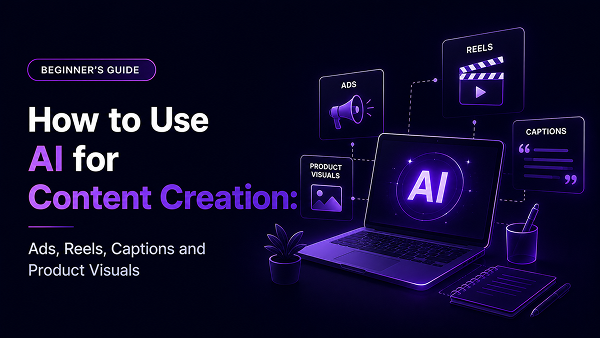
Learners should create real outputs such as AI images, product visuals, reel concepts, UGC-style ads, captions, voiceover scripts, campaign ideas, social media posts, and final project work.
The goal is simple:
Learn AI for real work, not just random experiments.
This matters because AI is becoming useful in everyday business, marketing, content, and creative work. A beginner does not need to become a technical AI engineer to start using AI. But they do need a practical method.
The Workflow Every Beginner Should Learn
Random prompts create random results.
Structured workflows create control.
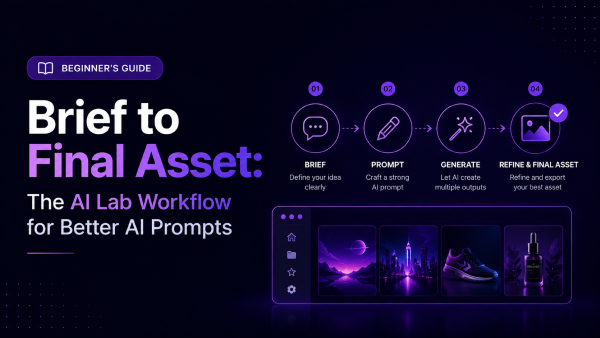
A good AI course for beginners should teach the full prompt-to-output workflow:
Brief -> Prompt -> Output -> Fix -> Refine -> Final Asset
This workflow is important because the first AI output is rarely perfect.
If you create an image, the first version may have poor lighting, wrong background, weak composition, or an unrealistic look. If you create a reel script, the first draft may sound too generic. If you create an ad copy, it may lack a strong hook. If you create a product visual, the product may not look premium enough.
A beginner should not stop at the first output.
They should learn how to diagnose what is wrong and improve the result.
That is where structured AI learning becomes valuable. The course should teach learners how to read the output, identify the issue, adjust the prompt, change the direction, and produce a better version.
AI does not become powerful only because you type a prompt. AI becomes powerful when you learn how to guide the output.
But Workflows Cannot Be Learned by Watching Alone
This is where many AI courses fail.
They explain the concept. They show a tool. They give a few prompts. But the learner does not get enough structured practice to understand how AI actually behaves.
AI learning is practical by nature.
You understand prompting better when you test different prompts. You understand image generation better when you compare multiple outputs. You understand video generation better when you see how motion changes with different instructions. You understand creative workflows better when you move from rough idea to final asset.
This is why beginners need more than lessons.
They need a practice environment.
Without practice, learners only remember tool names. With practice, they understand which tool to use, what prompt to write, how to improve the output, and how to turn an idea into something useful.
This is the bridge between learning AI and using AI.
Why AI Lab Access Changes the Learning Experience
AI Lab access matters because it gives learners a guided space to practice what they learn in class.
- The class gives the logic.
- The AI Lab gives the practice.
In live classes, learners understand the concept, the workflow, and the thinking process. Inside the AI Lab, they get guided exposure to useful AI engines and workflows so they can apply what they are learning.
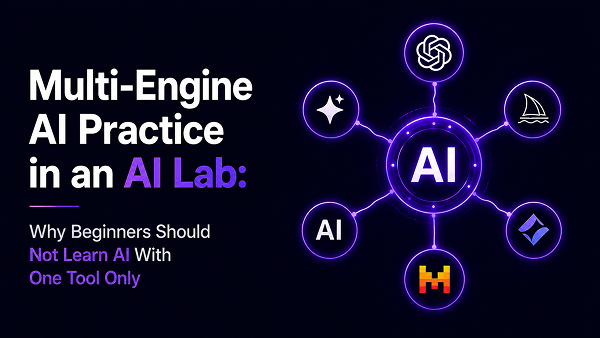
This solves one of the biggest problems beginners face: tool overload.
There are too many AI tools available today. Some are useful for writing. Some are useful for images. Some are designed for video generation. Some help with motion. Some are better for creative experimentation. Without guidance, learners waste time jumping between tools and subscriptions without knowing what to use and why.
AI Lab reduces this confusion.
The learner is not left alone after watching a demo. They get a structured environment to practice, test prompts, compare outputs, create visuals, experiment with videos, and understand which tool works for which task.
The point of AI Lab is not to make learners memorise tool names.
The point is to help them understand how different AI tools support different creative outcomes.
What Learners Practice Inside the AI Lab
Inside the AI Lab, learners get exposure to practical AI image and video workflows based on the current lab stack.
For AI video generation and image-to-video workflows, learners explore engines such as Kling and WAN, which help them understand motion, scene creation, and video experimentation.
For AI image generation and creative visual workflows, learners practice with engines such as Seedream, Nano Banana, and FLUX, which support image creation, visual experimentation, and high-quality creative outputs.
For AI video and visual storytelling workflows, learners also get exposure to tools like LTX, where they can understand how scenes, motion, and storytelling come together.
Along with these, the AI Lab can include more AI image and video engines depending on the current lab stack and learning requirement.
This gives learners practical exposure to different types of AI creation:
- Text-to-image
- Image-to-image
- Text-to-video
- Image-to-video
- Product visual creation
- Ad creative development
- Reel concept generation
- Campaign asset creation
- Creative refinement
This exposure matters because beginners often do not know which tool to use for which task.
AI Lab helps them practice in a guided way instead of getting lost in random tools.
Why Live Guided Learning Matters
AI tools can give output quickly, but beginners still need direction.
When learners start practicing, they usually face questions:
- Why is my prompt not working?
- Why does my image look unrealistic?
- Which tool should I use for this output?
- How do I improve this ad creative?
- How do I turn one idea into a full campaign asset set?
Live guided learning helps answer these questions.
This is where a practical AI course becomes stronger than random tutorials. Tutorials can show what is possible, but guided learning helps the learner understand how to do it.
Live classes provide structure, examples, assignments, and feedback direction. They help learners move from AI curiosity to AI output.
No Coding and No Perfect English Required
Many people hesitate to learn AI because they think it requires coding or perfect English.
For practical creative and business use cases, coding is not required.
If your goal is to create images, videos, captions, ads, reels, scripts, product visuals, or campaign ideas, you can begin with no-code AI tools and structured prompting.
Language should also not become a barrier. A learner may think in Hindi, Gujarati, Bengali, Hinglish, or English. The real skill is not perfect English. The real skill is learning how to convert an idea into a clear prompt that AI can understand.
Think in your language. Create with AI.
This makes the course more practical for Indian learners, especially beginners who want to use AI for real work but do not come from a technical or perfect-English background.
Who Is This Course For?
A practical AI course can support different types of learners.
For students, it can help build portfolio-ready outputs such as AI images, campaign ideas, reel scripts, product visuals, and creative projects.
For business owners and MSMEs, it can help create faster marketing content such as social posts, captions, product creatives, ad ideas, and campaign assets.
For creators, marketers, freelancers, and agencies, it can improve speed, concepts, visual direction, and client-ready workflows.
One GenAI course can support three practical paths:
Career, business, and creative work.
What Our Practical Gen AI Course Focuses On
Our Practical Gen AI Course is built for learners who want to create with AI, not just watch AI demonstrations.
The course focuses on practical creative and business use cases such as prompt engineering, no-code AI tools, AI image generation, AI video generation, ad creatives, reel concepts, product visuals, captions, voiceover scripts, campaign ideas, and final project work.
It includes live guided classes, AI Lab access, hands-on assignments, and output-based learning.
Learners practice workflows such as text-to-image, image-to-image, text-to-video, image-to-video, prompt-to-output refinement, campaign asset creation, product creative generation, and social media content creation.
The course is not designed as a heavy coding program. It is designed for beginners, students, business owners, creators, marketers, freelancers, and agency teams who want to use AI in real work.
The learning goal is clear:
Stop watching AI tricks. Start building AI workflows.
Capstone Project: Finish With Real AI Work
A good AI course should not end with only a certificate.
Learners should complete a practical final project that brings together what they have learned.
A capstone project helps learners apply prompt writing, tool selection, image generation, video workflow, creative direction, refinement, and final output creation.
This could be a campaign asset set, product creative workflow, reel concept series, AI-generated visuals, ad script set, or another practical project based on the course structure.
The purpose is simple:
Finish the course with a real AI project, not just a certificate.
AI Course Fees in India: What Should You Compare?
When comparing AI course fees in India, do not judge only by price.
A cheaper course may not be valuable if it only gives recorded videos and no practical output. An expensive course may also not be useful if it does not match your goal.
Before joining any AI course in India, compare the value behind the fee.
Ask these questions:
- Is the course beginner-friendly?
- Does it require coding?
- Are the classes live, recorded, or both?
- Does it include AI Lab access or guided tool practice?
- Does it teach prompt engineering?
- Does it cover no-code AI tools?
- Will you create images, videos, ads, reels, and content assets?
- Are there assignments?
- Is there a capstone project?
- Will the course help with career, business, freelancing, or creative work?
The right AI course should help you build practical ability.
A certificate is useful. Real output is more valuable.
Checklist Before Choosing an AI Course in India
Before you enrol, use this checklist:
- The course teaches practical GenAI, not only theory.
- It includes guided practice with useful AI tools.
- It offers AI Lab access or structured tool exposure.
- It does not require coding for beginner use cases.
- It teaches prompt engineering.
- It covers content creation, image generation, and video workflows.
- It helps learners create real outputs.
- It includes assignments or practice tasks.
- It supports students, business owners, creators, or marketers.
- It includes a final project or capstone output.
If a course meets most of these points, it is more likely to be useful for a beginner.
Frequently Asked Questions
Is coding required to learn AI?
Coding is not required for beginners who want to use AI for content creation, marketing, image generation, video creation, business communication, freelancing, or creative workflows. Many practical AI tools are no-code and can be used through prompts and guided workflows.
What is the best AI course for beginners?
The best AI course for beginners is one that explains AI simply and helps learners create real outputs. It should include prompt engineering, no-code tools, AI Lab practice, image generation, video workflows, content creation, assignments, and a final project.
Why is AI Lab access useful?
AI Lab access is useful because it gives learners guided exposure to practical AI tools and workflows. Instead of getting confused between multiple tools and subscriptions, learners can practice image, video, content, and creative workflows in a structured way.
Final Thoughts
The best AI course in India is not the one that only sounds advanced.
It is not the one that shows the most tools or gives the longest list of modules.
It is the one that helps beginners build practical AI workflows and create real output with confidence.
In 2026, AI learning should be practical, guided, and output-focused. Learners should not only understand what AI is. They should learn how to use prompts, no-code tools, AI Lab practice, image generation, video workflows, and refinement to create useful assets.
A practical GenAI course should help you move from curiosity to creation.
It should help you turn one idea into images, reels, ads, captions, product visuals, campaign assets, and final project output.
Start Your AI Journey Today
Join India's #1 Generative AI course and master the future of creative intelligence.